|
MODEL 1876 PRAIRIE BELT – THIRD PATTERN - CAVALRY
MODIFICATION w/ EXTERIOR CAVALRY ACCOUTREMENT STRAP AND SABRE SLING
HANGER LOOPS – VERY RARE AND EXCEPTIONAL INDIAN WARS
CARTRIDGE BELT: One of the extremely few of
these modified Model 1876 Prairie Belts that survived
use in the field during the Indian Wars to appear today
in modern collections, this belt is an exceptional
example of the frontier soldiers’ efforts to adapt the
standard issue equipment to meet their needs on
campaign. This belt is of the same style as pictured
and discussed on pages 243-46 of American Military
and Naval Belts, 1812-1902 by R. Stephen Dorsey.
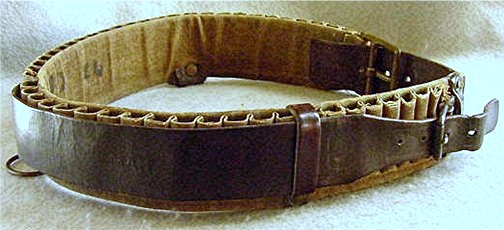
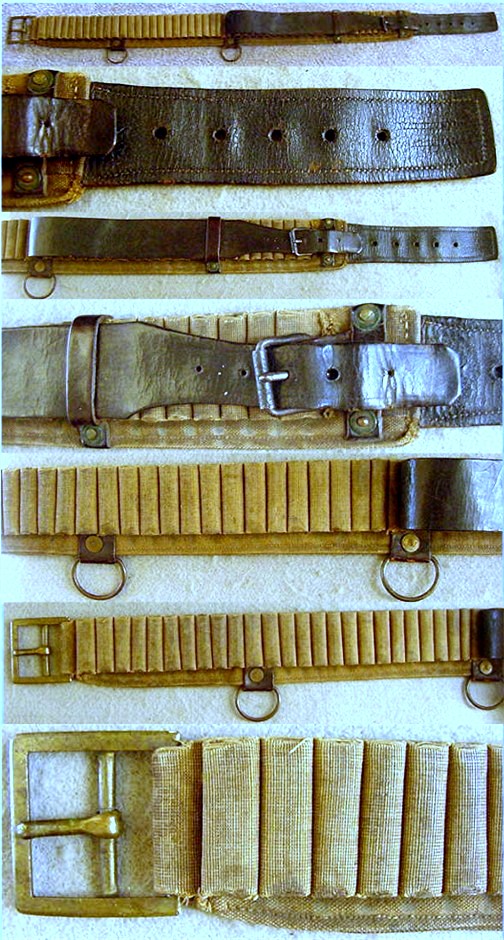
This Model 1876, Third Pattern Prairie Belt was modified
by the cavalry trooper with the addition of a 1 ¾” wide
leather strap, secured between the 22ND and
23RD cartridge loops with a single line of
stitching. The strap is supported and held against the
prairie belt body by a single ½” wide leather strap
folded over the belt and attached by a rivet on the
lower edge of the belt.
The applied strap is
tapered at its leading end, forming a billet with holes
to engage the tongue of a small iron buckle riveted to
the belt body where it meets the original leather
billet. This arrangement allowed the exterior belt to
remain buckled and secured in place when the belt billet
was unbuckled when the soldier took off the cartridge
belt. This additional strap allowed the soldier to
carry his revolver holster, pistol cartridge pouch and
possibly a sheath knife.
Two round brass rings are attached to the belt with
leather chapes along the bottom edge of the belt, each
with a single rivet. These rings are positioned, and
are of a size that they were certainly intended as
attachment points for sabre straps. They would have
accommodated the regulation sabre straps which were
issued with the Model 1874 Cavalry Sabre Belt, but it is
just as likely that the soldier fashioned a pair of
sabre straps from whatever leather was available at his
frontier post.
Another observation regarding the fittings on this belt
is worth noting – there has been a long standing
discussion among collectors and historians as to whether
or not the post-Civil War Indian War cavalry soldiers
carried their sabres into the field against the hostile
Indians. While anecdotal citations in some primary
sources make mention of the solders carrying their
sabres in the field, other glaring absences present a
counter argument that they did not – one of the most
prevalent is the historical record which documents the 7TH
Cavalry did not carry their sabres on their fateful ride
to the Little Big Horn. The presence of sabre strap
rings on this belt, and several other known examples
with the same modification, indicates that carrying the
sabre was important enough to include the addition of
the rings in the process of this modification. If the
troops were not inclined to carry the sabres, or their
officers thought the sabres superfluous, its doubtful
the rings would have been attached
That so few of these modified accoutrements survive
today can be easily explained when viewed through the
Ordnance Department’s process of issue and return. When
the units received new issues of current equipment and
returned the obsolete accoutrements and equipment to the
Ordnance Depots, those pieces that had been modified
such as this belt were looked upon by the Ordnance
Department personnel as damaged beyond repair, or the
necessary repairs to return the item to its original
configuration were not cost effective – especially since
it was obsolete equipment. It is very likely the
majority of modified pieces were condemned and destroyed
with the other unserviceable equipment. These belts
simply did not survive to be funneled into the surplus
sales that would eventually lead to the collectors’
market, hence their rarity today.
The belt has an overall length of 39”. As all of these
belts as issued were simply too long for the small
waisted cavalrymen of the period, the leather billets
were commonly shortened to fit the soldier – in this
case, the billet has been shorted to 7 ½” long. When
the billet was shortened, the soldier also shortened the
length of the belt body, reducing the number of
cartridge loops from the standard 54 to 48, and the
length of the belt body to 29 ¾”.
All of the loops are intact and show the expected wear
for such a field used belt along the top and bottom
edges of the loops, but not so worn as to collapse or
lose their integrity or shape. The belt body is very
strong with no tears in the canvas on the outside or
inside surfaces, and the seam along the bottom is fully
intact.
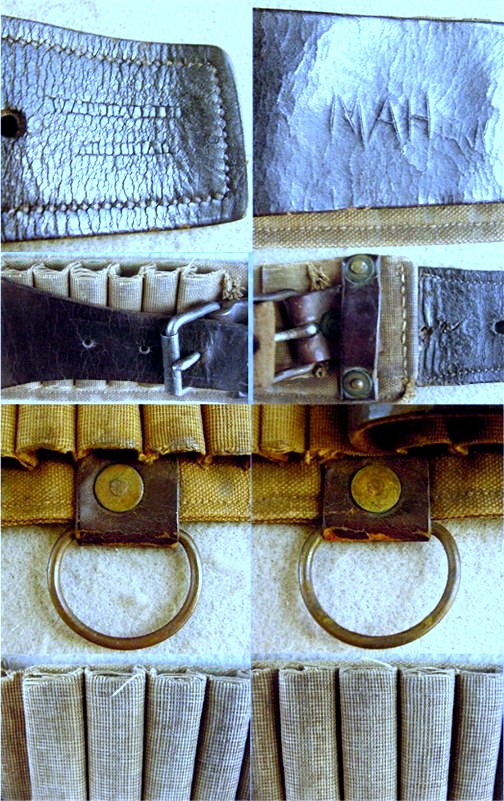
The tongue is surprisingly smooth with a shiny leather
surface, no crazing, and only minimal flexing. The
“WATERVLIET ARSENAL” stamp is still legible on the tip
of the tongue, and the stamped name of the inspector, A.
R. Smith, at the very tip is still legible.
The added strap on the
exterior of the belt is likewise in excellent condition
with signs of use, but no crazing and has an overall
smooth surface. The exterior belt bears a set of carved
initials, “MAH”, likely those of the soldier who was
issued this belt. The two leather straps that retain
the added strap and the matching small buckle billet are
likewise smooth, have no crazing, and are firmly
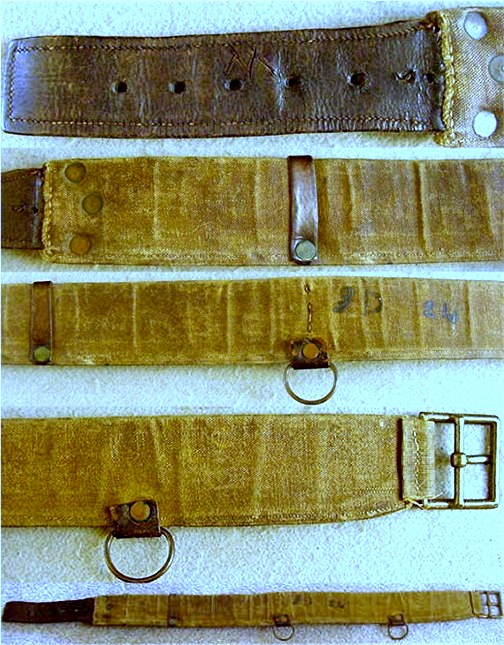
attached. The inside surface of the belt is marked with
what appears to be lightly applied branding with a hot
tool of some sort, “JD” and “24”, possibly the name and
number of the soldier who wore this belt.
The small number of surviving modified accoutrements
serves as quiet testimony of the efforts of the soldiers
and the Ordnance Department to adapt stocks of surplus
and current equipment to meet the needs encountered on
the Frontier. In spite of the number of these belts
that must have been modified during the period,
surviving examples such as this one are rare and they
are a fascinating field of collecting in their own
right. This extraordinary belt is of the scope and
quality to serve as the center piece in a collection of
early Indian War cavalry accoutrements and arms.
(0541)
$2200
|