|
MODEL 1881 ROCK ISLAND ARSENAL SINGLE ACTION
HOLSTER MODIFIED TO CARRY THE COLT 1878/1902 PHILIPPINE
CONSTABULARY REVOLVER – A SCARCE ARSENAL OR SOLDIER
MODIFIED HOLSTER:
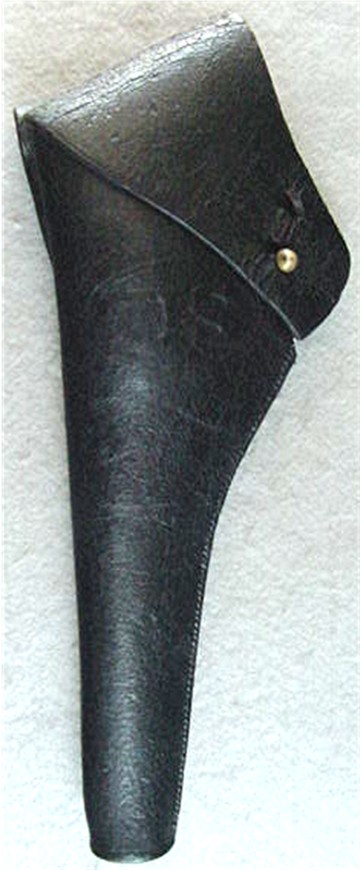
This Model 1881 Holster is
one of those modified at the Manila Ordnance Depot or by
a soldier serving in the Philippine Islands
for use with the M1878/1902
Colt “Philippine Constabulary” Revolvers.
A story well documented in
numerous books and articles - in short, the Model
1878/1902 Colt Revolvers were developed to meet a
requisition for pistols for the Philippine
Constabulary. The pistol featured an oversized trigger
guard to accommodate a longer trigger and the resulting
larger profile of the guard would not allow this pistol
to fit into the standard Model 1881 Holsters.
In a classic example of missed or nonexistent
communications, as one Ordnance Department team designed
and produced the revolver, the leather shops at Rock
Island Arsenal (RIA) received no, or incorrect,
information regarding the increased dimensions of the
trigger guard and the need to enlarge the holster. RIA
was obviously aware of the revolver’s production as in
1902-1904 their work shops manufactured a quantity of
holsters expressly designed for the Model 1878/1902
pistols and embossed “PC” on the holster body. However,
when received in the Philippines by September of 1902,
the initial shipment of these RIA holsters were reported
to be not sufficiently sized to fit the Model 1878/1902
Revolvers, initiating an exchange of correspondence
between the Philippines and the Ordnance Department over
several months to correct the problem.
The correspondence included a proposal as to how a
quantity of the standard Model 1881 Holsters embossed
with the regulation “US” which were on hand at the
Manila Ordnance Depot could be modified. In order to
enlarge the holster body and still maintain the
integrity of a closed holster, the approved modification
consisted of opening the top of the seam of the holster
and into this gap was inserted a leather gore which was
sewn and riveted in place. This solved the problem at
hand; however the Model 1878/1902 Revolvers had been in
the hands of the Constabulary for some nine months
without an appropriately sized holster in which to carry
them.
As the Model 1878/1902 Pistols had been delivered to the
Philippines in January of 1902 before Rock Island
Arsenal produced any of the “PC” holsters, it stands to
reason that immediately after receipt of the pistols it
was determined that they would not fit in the standard
pattern Model 1881 Holsters. While the Philippine
Constabulary awaited delivery of the holsters promised
from RIA, one would think some effort was made to modify
the Model 1881 Holsters on hand in order to satisfy the
immediate need for holsters and put the new pistols into
service. Although the addition of the gore as described
above eventually became the approved modification, the
initial modifications were probably considerably simpler
and perhaps a bit more crude.
The most basic approach would have been to cut away that
portion of the leather interfering with the enlarged
trigger guard – “…there…I fixed it!” Not pretty
and certainly not finished off to arsenal workshop
standards, but it worked, and the removal of the leather
did not appreciably affect the integrity of the
holster.
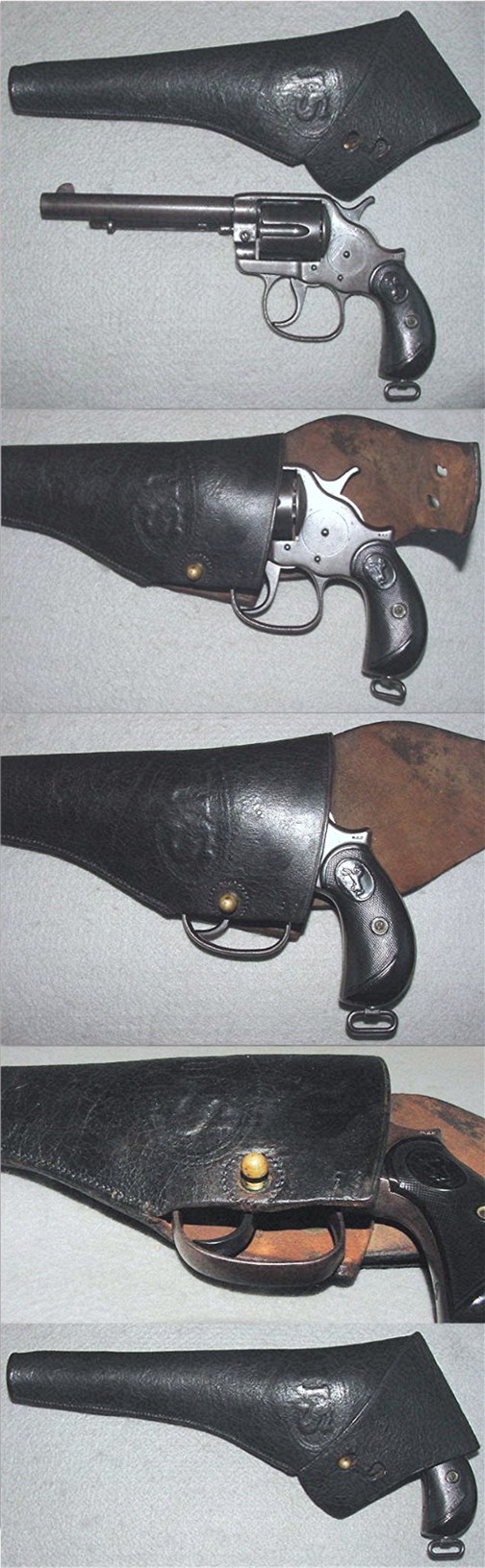
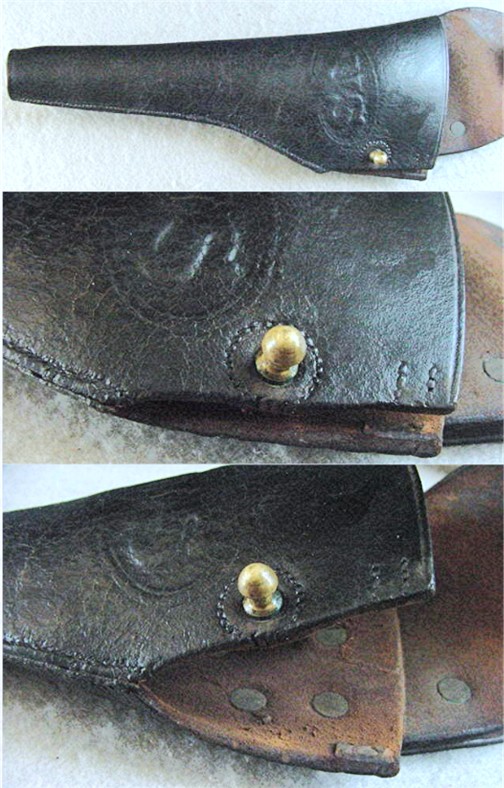
This holster exhibits that very same approach
to the problem and it presents as an immediate solution
which would have worked – the leather on both sides of
the top of the seam were cut back so as to clear the
enlarged trigger guard of the Model 1878/1902 Pistol.
This holster was obviously used in service after the
modification was made, showing wear and polishing to the
edges of the cuts. The cuts on this holster were made
in the same area and are of the same general length as
the opened seam on those holsters which were later
subjected to the more finished modification with the
gore installed. This similarity suggests the
possibility that this holster was a precursor to that
more finished modification and that this holster may
represent the earlier and more immediate modification
before the addition of the gore was developed as a
working model.
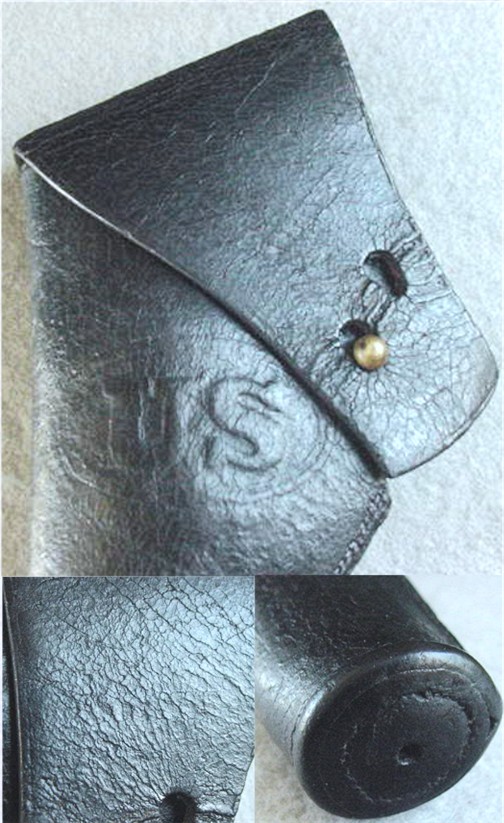
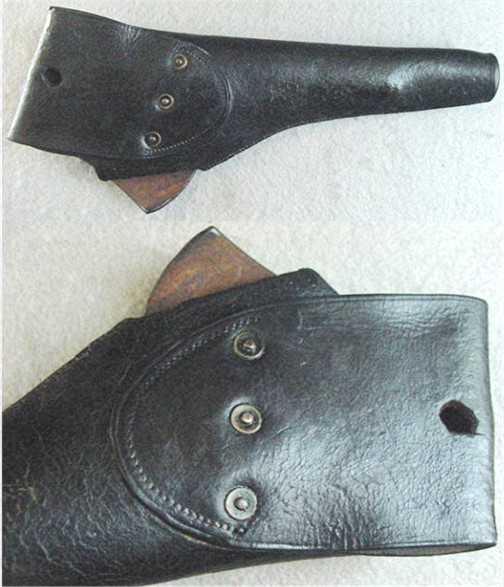
This holster shows evidence and wear commensurate with
service in the Philippines, however holster body, flap
and belt loop are solid and hold their shape and form.
The “US” in the oval is strong and complete and the ROCK
ISLAND ARSENAL stamp on the flap is faintly legible.
The overall surface of the holster is crazed, but
stable, all of the rivets and seams are intact, and the
plug at the bottom of the holster body is present.
There is a hole centered on the reverse of the belt loop
where the holster may have been riveted in place on a
belt to keep it from sliding out of position.
There are any number of reasons for the relative
scarcity of these modified holsters – that the
modification was done at the Manila Depot, far from the
continental United States; the unforgiving tropical
climate and its destructive effects on leather; and
likely hard use during their period of service; all
taking a toll and arguing against the holsters survival
to reach the modern collector market. This is a
particularly nice specimen and an excellent
representative of an interesting chapter in the
development, manufacture and issue of special
accoutrements by the Ordnance Department.
SOLD
NOTE:
I was given the opportunity to photograph this holster
with a nice specimen of the Philippine Constabulary
Model 1878/1901 Colt Revolver by local friend and
advanced collector, Ron Norman. His generosity
with the loan of the pistol is very much appreciated as
it allowed me to show this holster in the context in
which it was created and used. Ron has built one
of, if not the most, comprehensive collections in
private hands of the weapons, accoutrements, uniforms,
photographs and documents related specifically to the
Philippine Constabulary during the pre-World War One
period. Given the short period of history
involved, the remote part of the world in which the
limited numbers of personnel assigned to the
constabulary served, and the low survival rate of their
special equipment, the depth of Ron's collection is, at
the very least, quite impressive. His offer of
this pistol is very characteristic of the generosity
that was once so commonplace among collectors of
militaria, and only one of many reasons I consider him a
valued friend.
|