|
MODEL 1881 COLT/S&W HOLSTER
WITH THE FORSYTH MODIFICATION WITH AN ATTACHED MODEL
1875 PISTOL CARTRIDGE POUCH – INTERESTING AND WELL
DOCUMENTED SOLDIER ADAPTATION – VERY GOOD SPECIMEN OF A
SCARCE INDIAN WAR HOLSTER:
As described in US
Military Holsters and Pistol Cartridge Boxes, by
Scott Meadows on pages 128-132, the Forsyth Modification
of the standard Model 1881 Holster originated with
soldiers serving in Texas along the Mexican Border. By
the mid-1880’s the frontier troops were being issued a
combination of Model 1881 Holsters, designed and
intended to be worn on the leather sabre belts, and the
various patterns of the Mills Woven Cartridge Belts
which were far too wide to accept the narrow belt loop
of the holster. In order to overcome this problem, the
Texas based soldiers drew on the design of the holsters
in use by civilians of the period, and fitted the Model
1881 Holsters with what would become known as the
Forsyth Modification.
The Rock Island Arsenal made an original trial
production of 500 Forsyth Holsters. While the
modification was never formally adopted and it does not
appear that any additional Forsyth Holsters were
produced by the arsenal system, the modification was
very well received by the troops in the field. Based on
surviving specimens, additional Forsyth holsters were
created by modifying existing stocks of the standard
Model 1881 Holster – and such was the case with this
example.
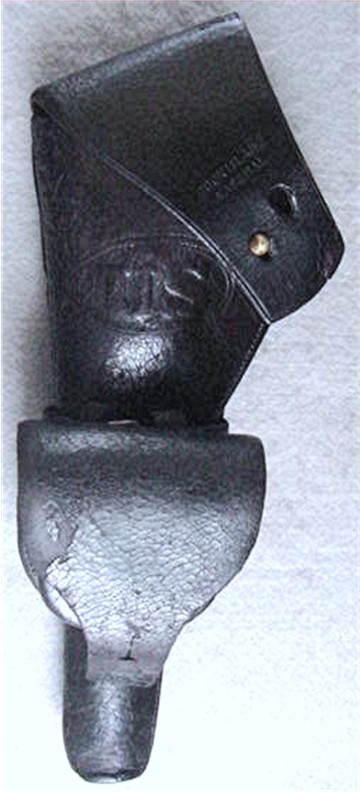
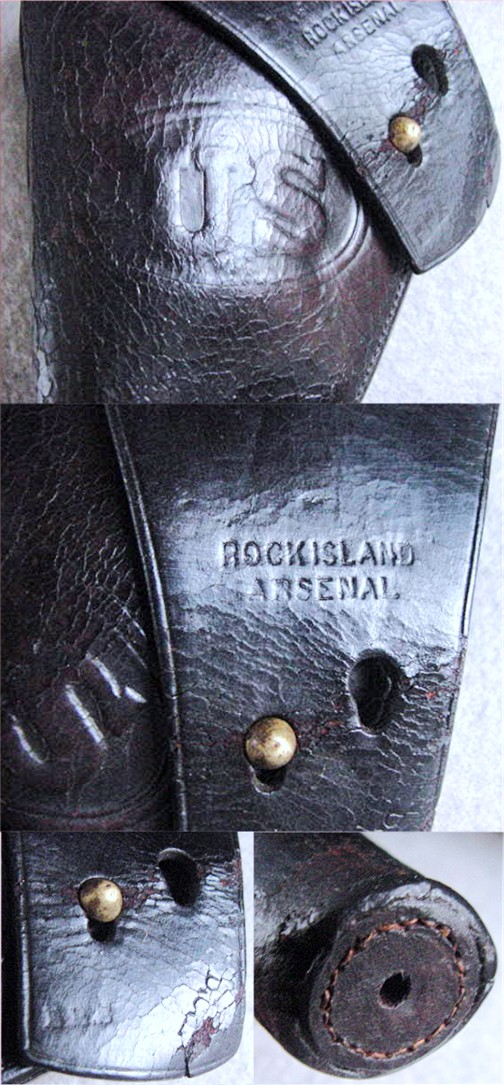
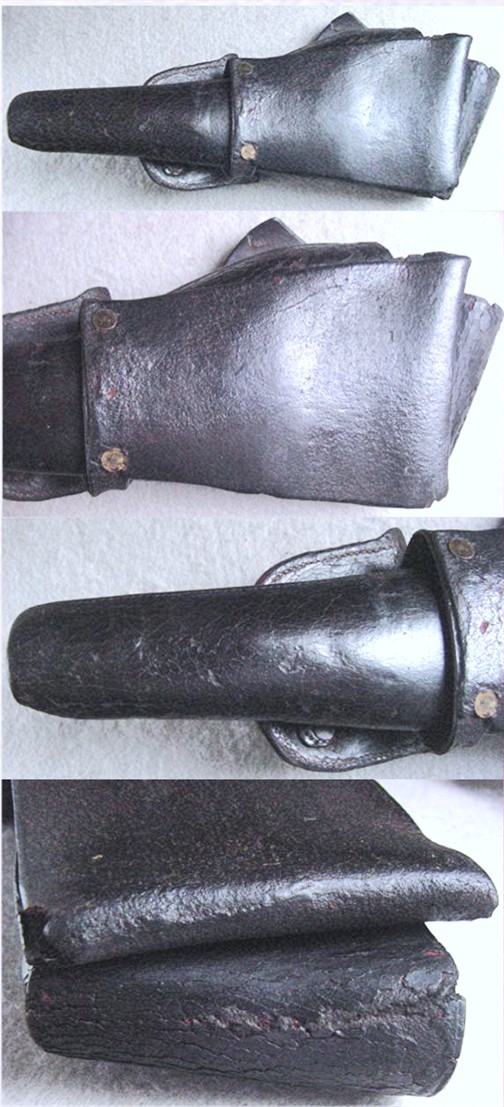
The condition of this specimen is very good, with solid
stitching throughout and with all of the components,
including the plug, intact. The body is solid, holding
its shape and form. The surface is crazed commensurate
with its use, but the leather surface still retains a
bright shiny surface, and a very legible “US” embossed
in the oval. The seams along the body and the bottom
plug are complete and intact and the plug is present.
The flap is overall smooth,
with only minor crazing, and the “ROCK ISLAND ARSENAL”
stamp and the inspector and piece worker initial stamps
are all very legible. At the top fold of the flap,
there is a narrow weakened strip that has been
repaired. It is not particularly noticeable from the
front of the holster as it lies behind the crest of the
fold, and is more visible on the interior of the flap.
The flap is still strong and not oil soaked, and that
one worn strip will survive just fine if the holster is
not roughly handled. The belt loop, one of the two
primary components of the Forsyth Modification is full
form, with the characteristic small wear points at the
forward and trailing corners of the top fold where the
loop passed over the belt and likely received the most
wear against the top edge of the cartridge belt. The
belt loop is otherwise very solid and the surface is
very smooth. The belt loop flap is held to the body of
the holster by the second component of the modification,
the retaining strap. The strap is full length and
intact with the proper brass buckle seen on many of
these modifications, and the surface of the strap is
commensurate with the balance of the holster.
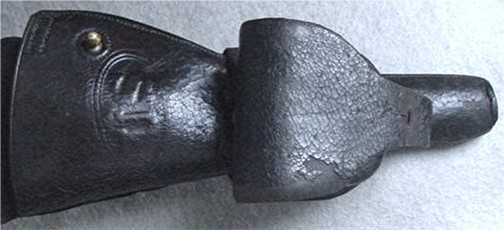
Setting this already scarce Forsyth Holster apart is the
very desirable soldier executed adaptation by suspending
his Model 1875 Pistol Cartridge Pouch from the holster’s
belt loop retention strap.
While the effects of aging and wear to the leather may
make this arrangement appear to be quite tenuous, when
the leather was new and at full strength and form, this
was a very functional solution to a problem that had
continued to plague the late Indian Wars soldier – that
of carrying his pistol cartridges when wearing the
canvas and woven cartridge belts. The army made no
provision for carrying the pistol cartridges on the
looped cartridge belts, and every solution for this
omission, such as this arrangement, was initiated by
soldiers serving in the field.
This concept may have originated as early as the Civil
War as at least one known example exists that
incorporated a mid-war holster with an unmodified cap
pouch, where the cap pouch was attached to the lower end
of the holster body with an added buckled strap, very
similar in form and concept to the arrangement on this
Forsyth Holster.
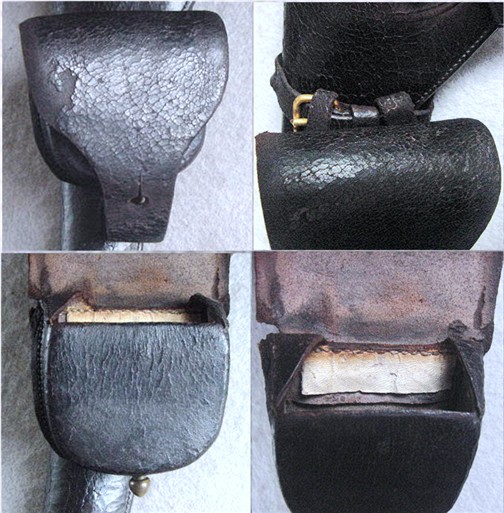
The pistol cartridge pouch exhibits use and wear
commensurate with that of the holster and is indicative
that the pair has been together since their active
service life. The surface of the flap is crazed with
some flaking, but the leather is strong and solid with
no weak points, and the integral closing tab is still
present and fully intact. In keeping with the
modification of the surplus Civil War cap pouches into
the Model 1875 Pistol Cartridge Pouches, the interior
flap was removed, leaving two “ears” which were sewn to
the top edges of the sides of mouth of the pouch in
order to retain the metallic cartridges. The face and
rear of the pouch are smooth with no serious surface
loss. Both belt loops are intact, and while showing the
wear to be expected as they are the suspension points
for the heavy cartridge filled pouch, they are intact
and full form.
The survival rate of any field modified accoutrements is
very low, and so many factors argued against their
survival. First, they are the pieces which “were
there”, exposed to the heavy use and hostile
environment of soldiers serving on the frontier, subject
to daily wear and tear, repeated wetting and drying, and
eventually worn to the point that they were consigned to
the burn pit. For those few examples of field modified
equipment which did survive the field and were returned
to the ordnance depots, the army regarded them as
outside the confines of the regulation patterns and
either disassembled them or disposed of them entirely as
condemned material, and those pieces did not survive to
enter the surplus pipeline which would eventually feed
the collector market.
In short, these holster and pistol cartridge pouch
combinations are quite rare, so finding a complete
pairing in any condition is very notable. In spite of
the obvious use which this set endured, it is quite nice
and it would be a great addition to an Indian War
collection.
These Forsyth Holsters are anything but common,
and a complete example such
as this specimen will be a special addition to your
collection to display with a Colt Single Action or Smith
and Wesson Schofield, and any of the Indian War Era
Mills Woven Cartridge Belts. Further, the added value
of having the Model 1875 Pistol Cartridge Pouch
suspended from the holster belt loop retaining strap
makes this specimen a very notable example, illustrating
how these Indian War holsters were adapted to the
soldiers’ needs.
SOLD
|