|
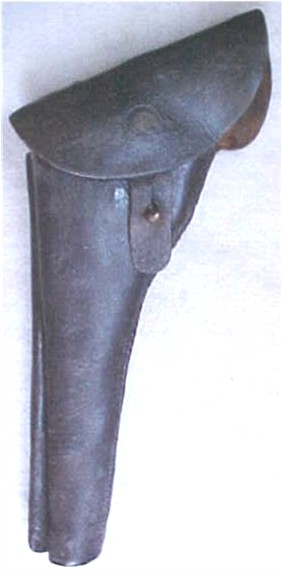
MODEL 1872 HOLSTER WITH THE HOFFMAN SWIVEL FOR
SINGLE ACTION REVOLVERS AND THE REMINGTON MODEL 1871 SINGLE
SHOT PISTOL – WITH WIPING ROD POCKET – A SCARCE EARLY
INDIAN WAR HOLSTER: As discussed in US
MILITARY HOLSTERS AND PISTOL CARTRIDGE BOXES by
Scott Meadows, pages 88 – 91, these Model 1872 Holsters
with the distinctive wiping rod pocket attached to the
body of the holster and featuring the Hoffman Pattern
Swivel Belt Loop were manufactured at Watervliet Arsenal
early in the post-Civil War Frontier period in very
limited numbers (estimated at just over 1300) and
survive today in very few collections - less than 20
specimens are known to exist. These holsters were
produced by modifying existing stocks of surplus US Army
Civil War revolver holsters by removing the standard
belt loop, evidenced by the line of stitching that
remains on this holster from where the original belt
loop was attached. The standard belt loop was replaced
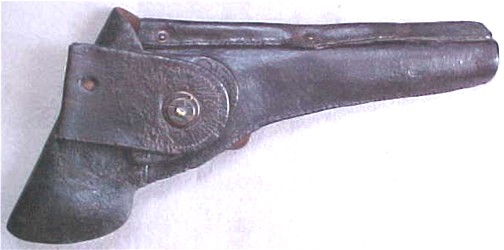
with the Hoffman Swivel assembly with the unrestricted
stud which allowed the holster to swivel a full 360
degrees around the belt loop assembly. The modification
was completed with the addition of the wiping rod
pocket, riveted to the length of the holster body and
the application of an embossed “US” in the oval on the
flap. The unrestricted swivel belt loop proved to be
one of the down falls of this design and efforts to
correct that failing are evidenced in this particular
holster, making it a particularly nice example for the
collection of a serious student of early Indian Wars
accoutrements.
This particular specimen retains a nice, even overall
smooth bright finish to all the surfaces, showing only
minimal evidence of the expected wear and aging, and
retaining the shape and form that it should have. The
“US” on the flap is no longer visible, either originally
lightly struck as many were and worn away through use,
or the US was never applied – it is well known that not
all holsters of this pattern were US marked.
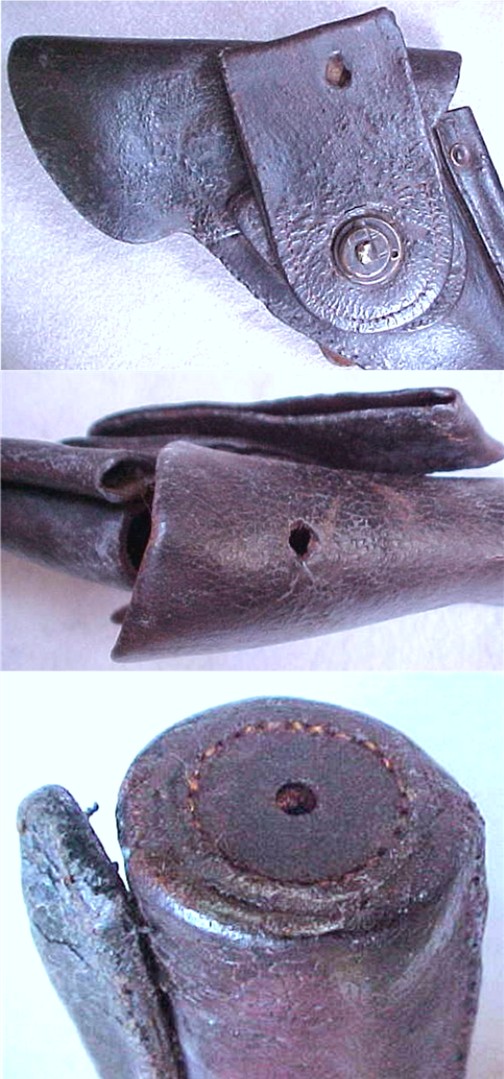
The swivel assembly is complete, fully functional, and
moves freely without being loose, but does show signs of
having been repaired, a common necessity highlighting
the aforementioned tendency of these swivels to fail.
As the swivel would rotate a full 360 degrees and was
made of soft brass, the soldiers experienced the fairly
regular, and I would imagine disconcerting, event where
the swivel assembly subjected to the constant friction
caused by the movement when worn on horse back
ultimately fatigued and simply fell apart. In addition
to the repair to the swivel, there is a hole in the belt
loop that is approximately the same size as the standard
rivet burr in use at the time, and the hole is in a
likely location where it appears as if the soldier
riveted the belt loop in place on his belt to steady the
holster and keep it in place.
The wiping rod pocket is full length and is attached to
the length of the holster body with two rivets. There
is a hole in the holster flap that lines up with the
upper opening of the wiping rod pocket, and this is
again an indication of the soldier’s attempt to cope
with the nature of the holster. One of the more common
complaints received from officers in the field regarding
this holster was when the holster rotated on the swivel
180 degrees, that is with the barrel in the upright
position, the pistol would fall out of the holster and
could or would be lost. Apparently the closing tab,
fitted over the closing finial was not sufficient to
hold the weight of the pistol if the holster was
upended. The soldier who carried this holster came up
with a fairly simple, yet ingenious solution for this
problem. Punching the hole in the flap to correspond to
the wiping rod pocket, he used the wiping rod as a
safety pin, relying on the friction of the leather of
the pocket along the full length of the rod to hold the
rod in place, and in turn hold the flap closed over his
pistol. The repaired swivel, the rivet hole in the belt
loop and the wiping rod hole in the flap are not the
troublesome inconsistencies that require explanations,
but rather very desirable indications of soldier applied
modifications and adjustments that they found necessary
to maintain the equipment and adapt it to service in the
field.
The condition of this rare holster is overall excellent;
all of the components are present and intact to include
the seam, closing tab and plug; and the flap, belt loop
and holster body all hold their shape and still retain
the characteristics of strong, live leather. There is a
small repair at the front edge of the fold of the flap
where the flap bent over the butt of the pistol, but it
is well executed and is not readily noticeable and it
does not affect the strength or integrity of the
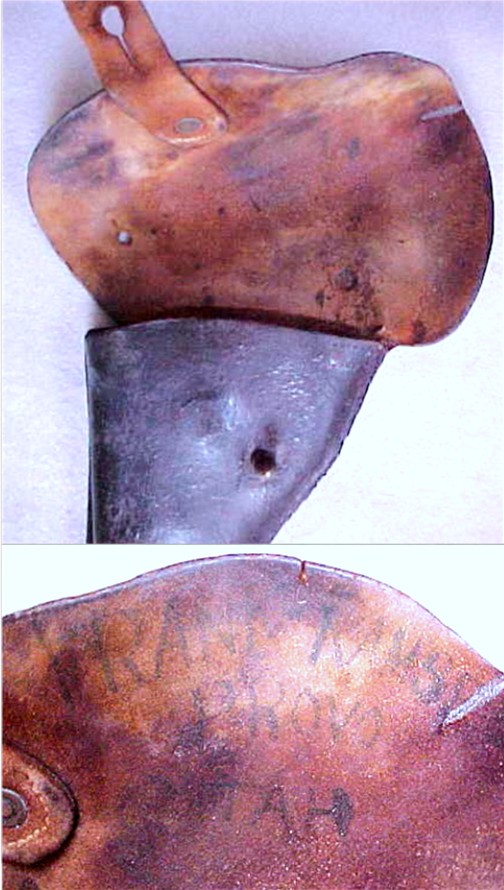
holster. The inside surface of the flap has an inked
inscription, “Frank Ramsy, Provo, Utah”, perhaps the
soldier who carried the holster or a civilian who found
a use for it after the army had disposed of it.
These early Indian War Model 1872 Holsters are recognized by
knowledgeable collectors as an important addition to an
Indian War Accoutrement collection and this holster will
be the perfect addition to display with your Colt
Richard Conversion, Smith and Wesson American, or Model 1871
Remington Single Shot Army Pistol.
SOLD
|