|
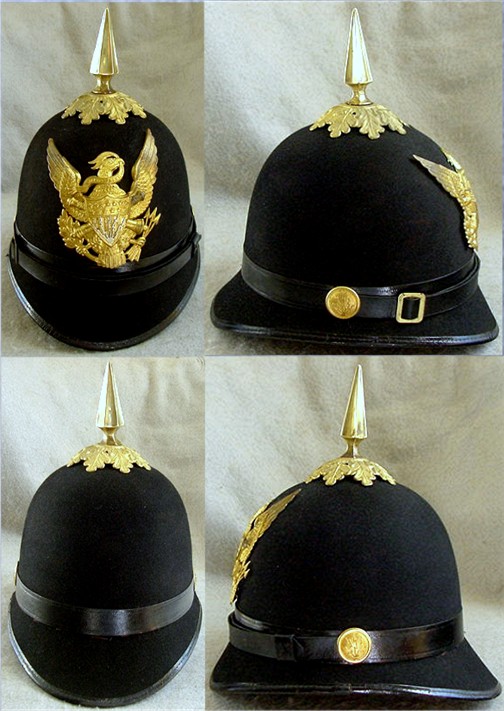
MODEL 1881 ENLISTED MAN’S ARTILLERY ELECTRICIAN’S
DRESS HELMET – A RARE SPECIMEN IN EXCELLENT COMPLETE
CONDITION: This is a very rare Model 1881
Enlisted Man’s Dress Helmet worn by an Artillery
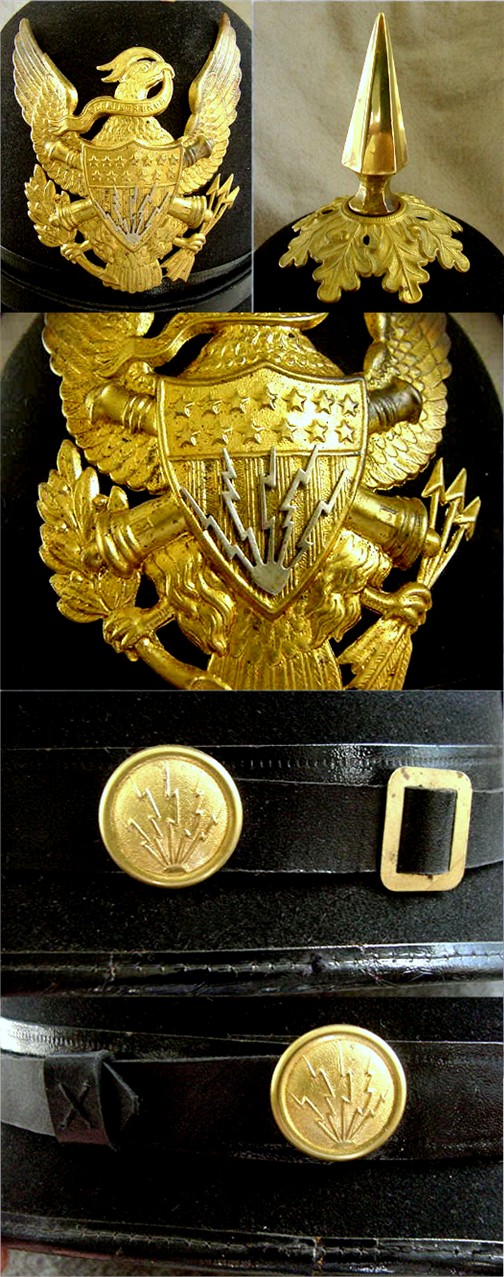
Electrician. While the helmet and all of the insignia
follow the 1881 regulations for these helmets, the
position of Electrician and this unique insignia of the
five arrayed lightening bolts did not come into being
until 1899. The occupational specialty of Electrician
combined with the 19TH Century Artillery may
seem like an odd pairing, but a little digging reveals
an interesting chapter of U.S. Army Artillery history.

The corps of artillery of the day was divided according
to the manner in which it was deployed on the
battlefield – the Light Artillery, composed of batteries
of lightweight field pieces which accompanied columns of
cavalry and infantry on campaign; Field Artillery, which
could deliver larger numbers of combined batteries to
the battlefield in support of, or to repel massed
attacks; Siege Artillery with its massive guns and
mortars designed to reduce the enemy’s fortifications
and strongholds; and the Coastal Artillery, likewise
armed with massive guns set in casements and earth works
which defended the nation’s harbors. In addition to
their large guns, the Coastal Artillery was also
responsible for deploying mines in the shipping lanes
and channels to deny the enemy ships access to the
harbors.
Mine warfare had been utilized in some form for hundreds
of years, but prior to being able to harness and direct
the application of electrical current, the use of water
borne mines was somewhat of a guessing game, reliant on
a strategy based on a great deal of luck and
happenstance. Keep in mind that friendly ships had to
be able to sail the same channels the enemy vessels use
to enter the harbors. All the good intentions to
protect the harbor wouldn’t count for much if you sunk
one of your own ships. Deploying mines at the entrance
to a harbor necessitated accurate maps, solid anchorage
to keep the mines in place where you put them – can’t
have them wandering all over the harbor at the will of
the tides and currents, and supervision of the safe
passage ways to ensure friendly shipping stayed within
the open channels.
In
the late 1890’s, with the advent of electrically
triggered mines, mine warfare took on a more dynamic
dimension. Tethered to the shore by a heavy cable
bearing an attached electrical conductor cable, the
mines could be floated out into the ship channels only
when needed, positioned most effectively to respond to a
specific threat or event, and when necessary, triggered
electrically from a control panel within the protection
of the casement to explode in close proximity to an
enemy vessel.

coast
artillery electric mine control panel Ca. 1900
This advancement in the use of mines presented at least
one significant problem – the army did not have any
electricians adequately trained to rig, maintain and
deploy the mines, the conductor cables or the control
panels housed in the casement fortifications, nor did
the service have the internal schools necessary to
adequately train and develop soldiers to man these
posts. The practical application of electricity was
still a rarified field of expertise and skilled
electricians, trained and experienced enough to operate
this sort of mine warfare system, were not common. In
1899 Congress authorized recruiting a force of 100
electricians who would be appointed as sergeants and
attached to the Coastal Artillery posts’ noncommissioned
officer staffs; however some have suggested that fewer
than 30 held the position of Artillery Electrician at
any one given time.
The introduction of these electrically controlled mines
heralded another step forward in technology which must
have been accompanied by a certain level of stress in
the ranks of the Coastal Artillery, evidenced by the
following verse which was penned by one of their
officers and published in a periodical circulated
through the army:
'Tis well I know how guns
are tripped, and mortar grease-cups shined;
With care in sweeping dust
from drains my weary brow is lined.
But now there rise before
my eyes wonders I have not seen:
I hear the loud alarm of
bells, and see red lamps and green!
One drops a mine into the
drink; 'tis fastened to a string;
The string runs out beneath
the bay so you can find the thing;
A milliameter is hitched
to th' end of this frail cord,
And the sergeant says you
can tell by that how the damn thing is, b'Gord.
I don't suppose I'll ever
know why you ground the A. C. switch,
And if I know why the red
lamp glows, I'll be a - - - - .”
This specimen of the Model 1891 Enlisted Man’s Artillery
Electrician’s Dress Helmet is in excellent condition.
Complete with all of the original correct trimmings and
insignia, to include the top spike and oak leaf base,
the correct electrician side buttons, the proper
Artillery eagle plate with the German silver
electrician’s insignia overlay, the leather chin strap,
and of course an excellent helmet body. The electrician
overlay and side buttons are quite scarce in their own
right and the presence of the original full length chin
strap is a definite added value as these are often
missing and are almost impossible to find on the loose.
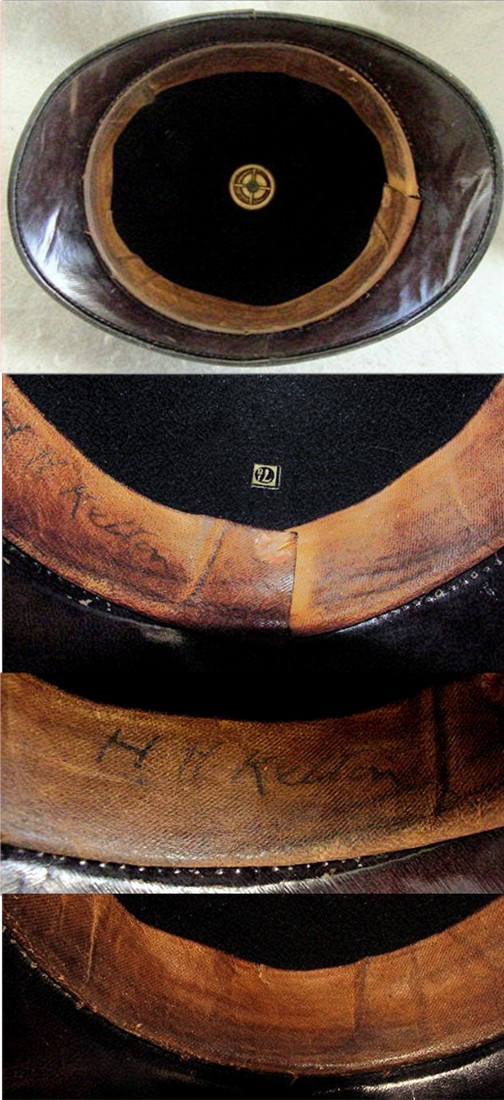
The helmet body is full form with no crushing, breakage,
loss of finish or other damage. The sweat band is still
intact and stitched in place with only minor surface
wear and staining. There is a name, “H. R. Kelton”
written on the band, likely the name of the soldier to
whom this helmet was issued. The original paper size
tag is still present above the rear of the sweat band.
It
is worth noting that this helmet was in use for only
three years – the Electrician occupational specialty
being introduced in 1899 and the Model 1881 Dress
Helmets being withdrawn from issue and wear in 1902.
The limited numbers of Electricians in the army at this
time resulted in surviving examples of their specific
lightening bolt insignia such as on this helmet and the
chevrons they wore on their uniforms being quite rare.
This is an outstanding example of the Artillery
Electrician’s Dress Helmet which is seldom found on
today’s market or in collections.
(0117) $750
|