|
PATTERN 1898 INFANTRY OFFICER’S TROPICAL UNIFORM
– COMPLETE WITH ALL THE PROPER INSIGNIA – VERY SCARCE
EARLY PATTERN IN VERY GOOD CONDITION:
Approved at the start of
the Spanish American War, these khaki colored, cotton
blouses were adopted with the issue of General Order No.
39 on May 9, 1898 and were to be trimmed with the color
of the branch of service (G.O. 51, May 23, 1898) - dark
blue for the staff departments and general staff, yellow
for cavalry, red for artillery, and sky blue for
infantry. The blouses for the enlisted men were to have
the trim colors on the collar, shoulder straps, breast
pocket flaps and cuffs, while these officer blouses were
trimmed in the branch color on the collar, shoulder
straps and cuffs.
Providing a very identifiable uniform for each branch,
unfortunately it was this very same distinction that
resulted in a very short service life for these
uniforms, making them quite scarce today. As the
uniforms were subjected to wear in the field, the army
quickly discovered that the wear out period for cavalry
and infantry soldiers and officers in the field was
considerably shorter than it was for artillery and staff
department soldiers, resulting in a serious shortage of
replacement uniforms for the mounted and foot troops
while an overabundance of artillery and staff uniforms
sat unissued in storage. Due to the way in which this
pattern of coat was trimmed, changing the color of the
facings in order to meet the need for uniforms was not
practical.
As a result, less than two months later, on July 15,
1898, the Secretary of War issued a circular directing
that while the design of the uniform blouse would remain
the same, the colored facings be eliminated and replaced
with colored detachable shoulder tabs that could be
issued with the later pattern all khaki coats as
appropriate for the soldier’s and officer’s particular
branch of service.
The next phase in the evolution of the tropical weight
cotton khaki uniform would occur the following year with
the introduction of the Pattern 1899 Tropical Uniform
which would completely replace the Pattern 1898
Uniform. Nominally made for only a few months - and
then most of those that were made being subjected to the
severe use and wear of combat soldiers in a tropical
environment - it is not surprising that these later
Pattern 1898 Tropical Blouses survive today in
relatively low numbers and when found, often show
evidence of hard use in the field. Further reducing the
likelihood of survival of these blouses was the common
practice of issuing new uniforms to troops returning
from the tropics and requiring that their old uniforms
be burned to prevent the introduction and spread of
disease within the continental United States.
Given the numerical proportion of officers to enlisted
men,
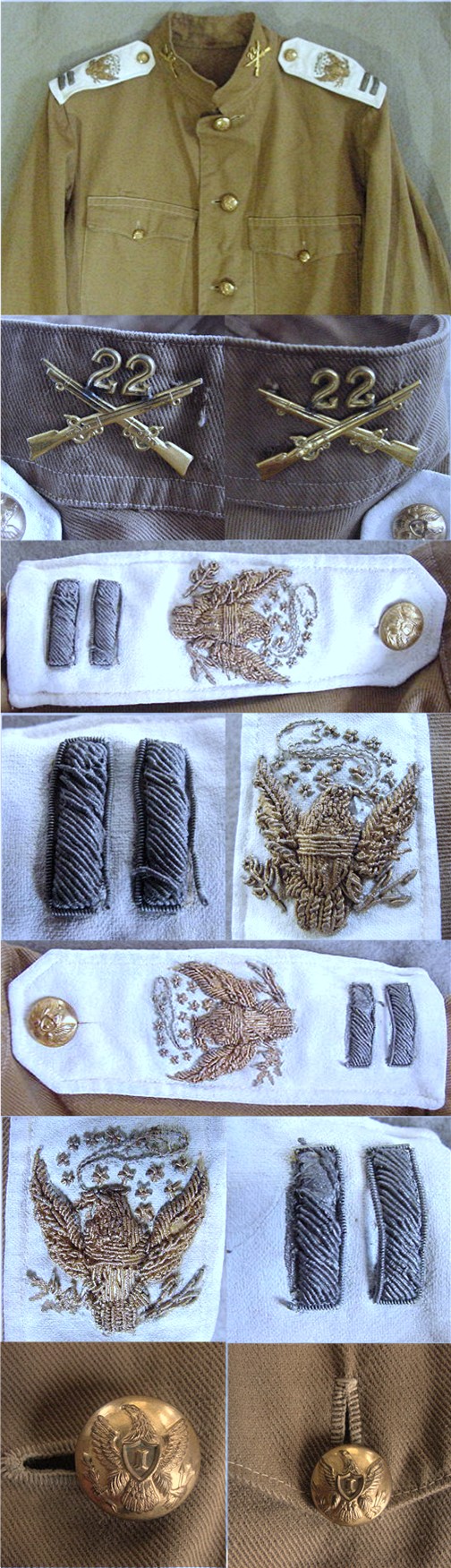
this Pattern 1898 Officers Blouse
which was worn by a captain
who served in the 22ND U.S. Infantry Regiment
is a very scarce offering.
This blouse and the Pattern 1898 Cavalry 2ND
Lieutenant’s blouse offered in a separate listing on
this site were acquired from the same old, well
established collection. Both blouses are, for all
intent and purposes, the same size, and more
significantly, both bear shoulder tabs which are
embroidered with bullion thread executed in the same
style and design indicating they were purchased by the
officer from the same uniform dealer. It was not
particularly unusual for an officer to transfer from one
branch of the service – in this case from cavalry to
infantry – sometimes for no other reason than an
opportunity for advancement and promotion presented
itself. The similarity of these two blouses strongly
suggests they were owned and worn by the same officer,
and given the additional cost of the embroidered
shoulder tabs versus those with the separate pin on
insignia, he may well have been a man of some means.
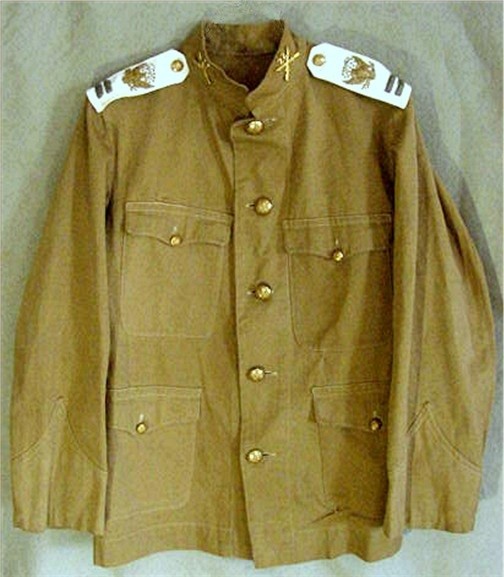
The captain’s rank is indicated on both
shoulder straps by the pair of embroidered silver
bullion bars and his rank is accompanied by the bullion
embroidered 1898 National Eagles worn by
all officers. The embroidery on both shoulder straps is
very well executed and is mostly full form, showing very
little wear. There are some loose thread ends and some
missing threads, but overall the embroidery has survived
the captain’s service in reasonably very good
condition. The white shoulder tabs are clean and full
form with no fraying. His assignment to the 22ND
Infantry Regiment is indicated by the insignias pinned
to the collar on each side of the throat
opening. All of the insignia is otherwise full form,
firmly attached, and all appear to be original to this
blouse.
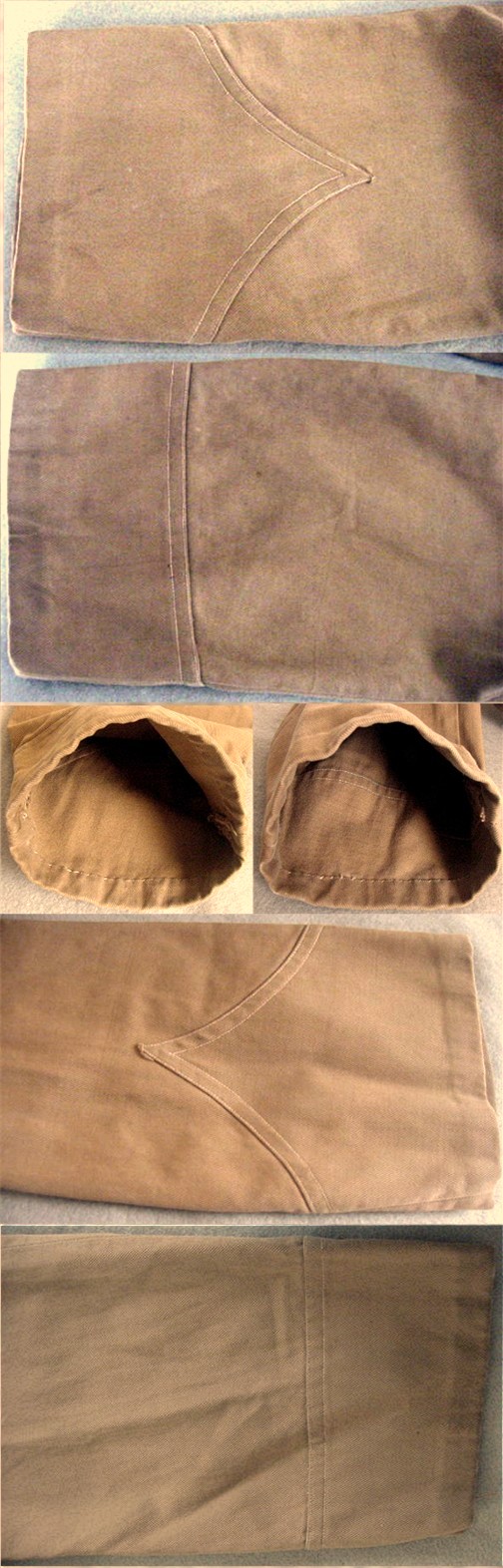
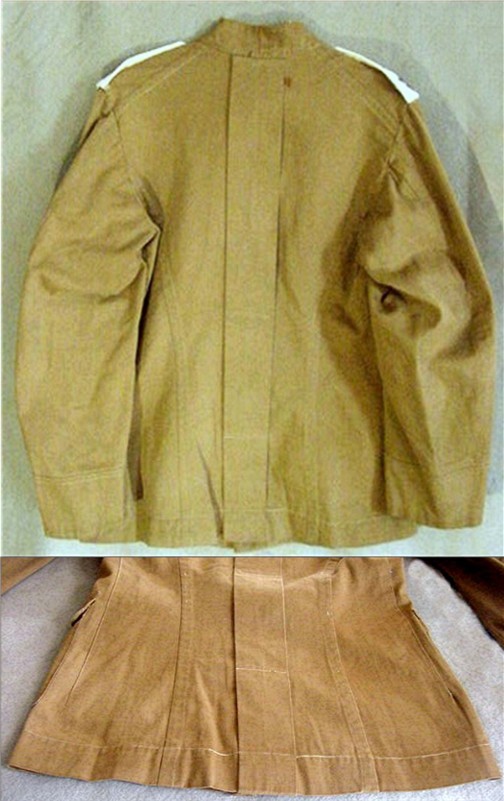
This uniform blouse shows the obvious signs of having
been issued and worn in the field, but it fared well in
service and the officer took good care of his clothing
both while in service and later stored it well. The
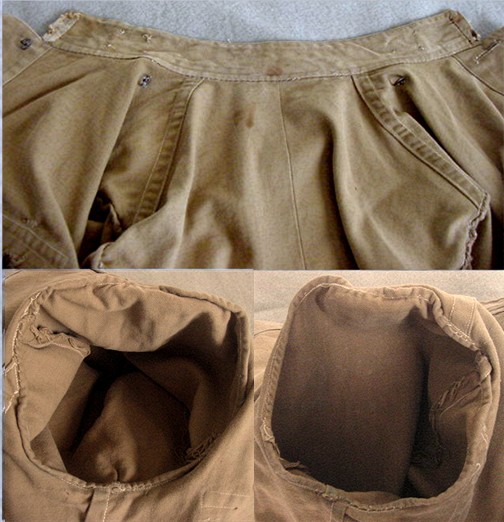
khaki fabric of the blouse is in overall very good
condition, with no deterioration, no open seams, and no
fraying to the edge of the collar. The exterior and
interior edges of the cuffs are smooth, intact, and show
no heavy wear, and there is no wear or seam separation
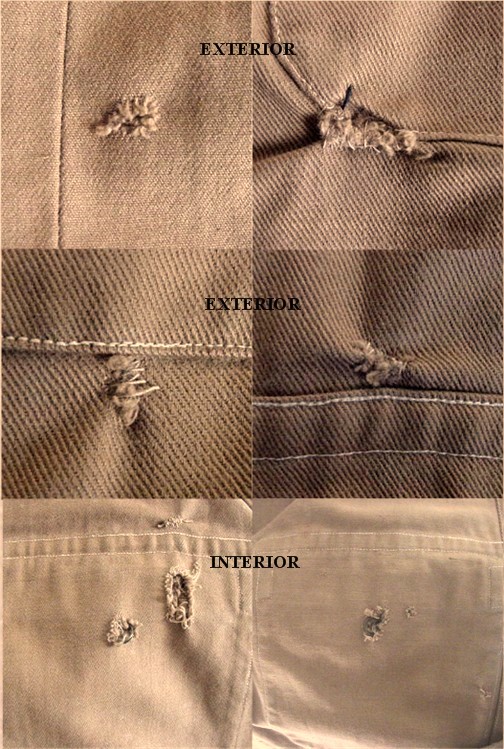
around the interior arm holes. There are three hand
sewn repairs - probably executed in the field - to small
holes – one above the right side breast pocket, one at
the bottom of the left side breast pocket, and one at
the bottom of the left side lower pocket. All three are
quite small and were probably the result of wear caused
by something the captain carried in his pockets. None
of these repairs are particularly unsightly and
certainly do not detract from the display quality of
this blouse. All of the matching original General
Service Infantry buttons (each bearing the correct “I”)
are present on the shoulder straps, front closure, and
pocket flaps. The bottom edge of the blouse is intact
without any of the characteristic fraying normally seen
on these blouses which saw use in the field.
This blouse is very clean with only one small stain high
in the center back, and it is so insignificant,
virtually unnoticeable when the blouse is on display, it
is only mentioned here in the spirit of a complete
description.
Introduced as our army was deployed to far away lands
and subjected to the sweltering tropical heat, this
scarce 1898 Officer’s Uniform Blouse shows some evidence
of the captain’s overseas service, but nonetheless, it
has survived in very nice condition and it will be a
particularly nice addition to a Spanish American War
display.
(0119)
$1450
NOTE: To say that photographing
uniforms is a challenge is an understatement. In normal
lighting, the cloth absorbs the light and none of the
finer features or condition details can be seen
clearly. In order to highlight the features and provide
you with an accurate view of the material, I have to
lighten the contrast of the photograph which in turn
causes even colored cloth to appear faded or discolored
when such is not the case. This coat is has an even
khaki color throughout as is seen in the close up
photographs. |